
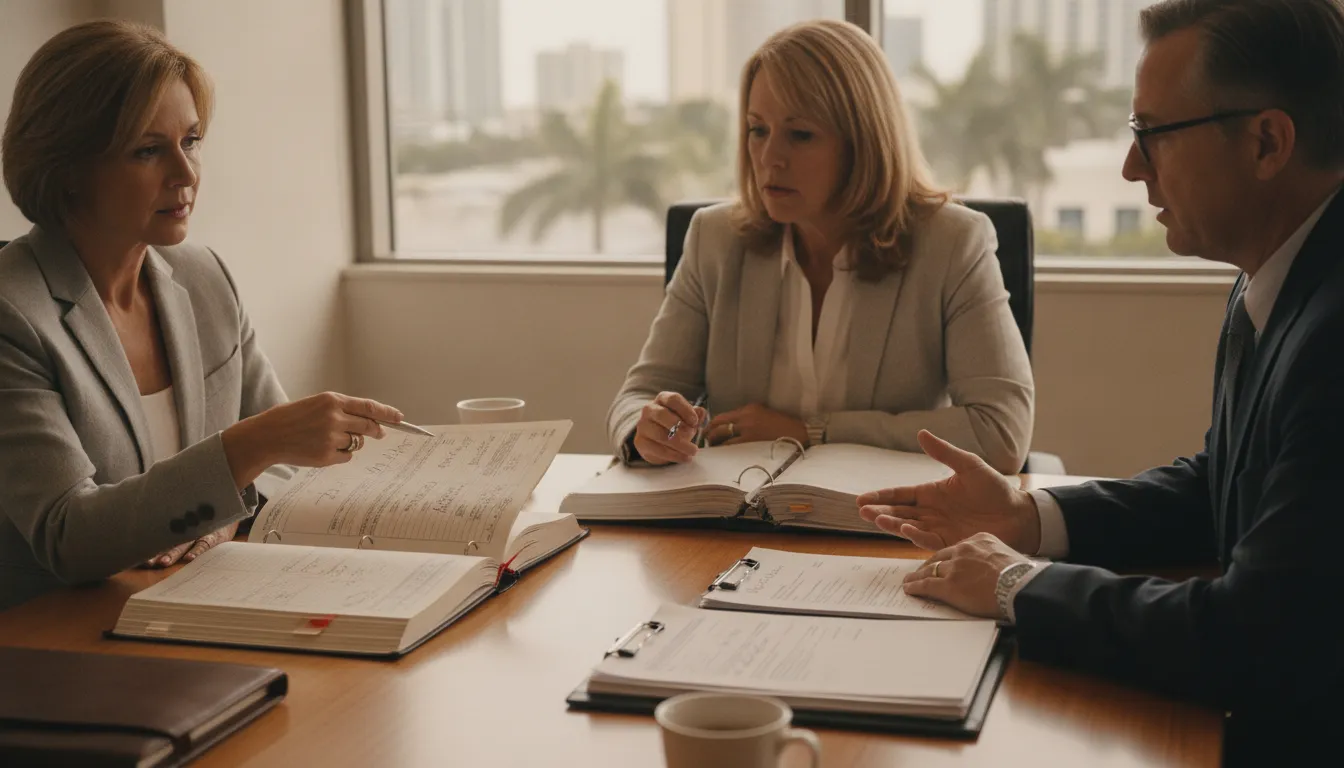
What should a Florida business expect if a partnership dispute goes to trial? A Florida partnership dispute trial is usually the end of a longer process involving the partnership agreement, pleadings, discovery, motions, settlement discussions, and preparation of documents and witnesses. The court may be asked to decide whether a partner breached an agreement or duty, whether the partnership should be dissolved or wound up, how accounts should be settled, or what other relief fits the proven facts. The answer will depend on the entity, governing documents, claims, defenses, evidence, and the court’s rulings in that case.
Call (786) 586-4477 to discuss a Florida partnership dispute
By Martin Feldman, Founder and Partner
This article provides general information, not legal advice. Partnership rights, litigation deadlines, remedies, and trial strategy depend on the entity, agreement, records, and particular facts. No result is promised.
What does it mean for a partnership dispute to go to trial?
A case goes to trial when the parties have not resolved the claims and the court is prepared to hear evidence and decide the issues that remain. “Trial” does not necessarily mean that every issue in the dispute will be presented to a jury. Some matters are decided by a judge, some claims may be resolved through motions before trial, and the parties may settle at any stage.
Before discussing trial, identify the type of business involved. Florida’s general partnership statutes do not automatically govern every business that owners casually call a partnership. An LLC, corporation, limited partnership, or joint venture may be controlled by a different statute and different organizational documents. The certificate, annual reports, operating agreement, bylaws, shareholder agreement, partnership agreement, amendments, and related contracts should be reviewed together.
For a South Florida business owner evaluating a dispute, Feldman Law’s business litigation services page provides an overview of the firm’s litigation work. A focused legal review can help separate the questions that truly need a trial from those that may be addressed through negotiation, an accounting, or another process.
What happens before a Florida partnership dispute trial?
Trial preparation usually begins well before the trial date. The sequence varies by case and court, but a business should generally expect several stages.
1. Pleadings define the dispute
One party files a complaint or other pleading stating the legal claims and the requested relief. The other side responds with an answer and may assert defenses or counterclaims. The pleadings are important because they identify the issues the court may need to decide, but they are not proof by themselves.
A partnership case might involve allegations about a breach of the partnership agreement, unauthorized transactions, misuse of partnership property, failure to provide records, disputed contributions or distributions, a buyout, dissociation, fiduciary duties, or the conduct of the business. A party may also seek a declaration of rights, an accounting, damages, an injunction, dissolution, or court-supervised winding up. The available claims and remedies depend on the entity and facts.
2. The court manages the case
The court may establish deadlines for adding parties, amending pleadings, exchanging information, completing discovery, filing motions, disclosing experts, and setting the case for trial. Missing a deadline can affect the evidence or arguments a party may present. A business should route litigation communications to counsel and preserve relevant records rather than assuming that an informal conversation will protect its position.
3. Discovery tests the evidence
Discovery gives each side a structured way to request information and documents, ask written questions, take depositions, and investigate the facts. In a partnership dispute, discovery may include:
- the partnership agreement and amendments;
- formation records, ownership schedules, written consents, and meeting minutes;
- bank statements, general ledgers, tax returns, financial statements, and accounting records;
- capital contribution, loan, distribution, and compensation records;
- contracts, leases, loan documents, guaranties, insurance records, and customer or vendor communications;
- emails, text messages, accounting-system data, and other electronic records; and
- documents supporting claimed losses, business value, offsets, or alleged unauthorized conduct.
Discovery is not limited to documents that help one side. A party must address unfavorable evidence as well as favorable evidence. It is also important not to delete, alter, or overwrite relevant electronic information. A preservation plan should be considered promptly when litigation is likely, particularly if the dispute concerns access to accounts, control of systems, or possible transfers of partnership property.
How does the partnership agreement affect the case?
The partnership agreement is often the starting point for determining the partners’ rights. Under Florida Statutes section 620.8103, relations among partners and between partners and the partnership are generally governed by the partnership agreement. If the agreement does not address an issue, the statutory rules may supply a default rule.
The agreement may contain provisions about voting, management authority, access to books and records, capital calls, profit and loss allocations, withdrawal, dissociation, expulsion, valuation, buyouts, notice, mediation, arbitration, venue, and attorney fees. It may also define events that trigger dissolution or winding up. A court must read the applicable language with the rest of the agreement and the evidence that the law permits the court to consider.
The agreement is important, but it does not automatically answer every question. The court may need to decide whether a provision applies, whether a condition occurred, whether later conduct changed or waived a requirement, whether a party complied with notice procedures, or whether a requested remedy is available. Florida law also limits how an agreement may vary certain rights and duties. An owner should not assume that a clause resolves the dispute without reviewing its wording, the entity structure, and the surrounding records.
When can a Florida partnership be dissolved or wound up?
A trial may concern the continued operation of the business, the departure of one partner, or the end of the partnership itself. Under Florida Statutes section 620.8801, dissolution and winding up may follow events described in the statute, the partnership agreement, or a judicial determination. For example, a partner may apply for a judicial determination when the economic purpose is likely to be unreasonably frustrated, another partner’s conduct makes it not reasonably practicable to continue in partnership, or continuing in conformity with the agreement is not otherwise reasonably practicable.
Those standards do not mean that every disagreement requires liquidation. A court must evaluate the agreement, the business’s operation, the evidence, and the relief requested. A partner’s preference to leave, a management disagreement, or an allegation of unfairness may raise important questions, but the legal standard and the requested remedy still have to be established.
After dissolution, a partner who has not wrongfully dissociated may participate in winding up, subject to the statutory rules. Under section 620.8803, the circuit court may order judicial supervision of winding up for good cause shown. Winding up can include preserving the business for a reasonable time, collecting or disposing of property, addressing liabilities, and prosecuting or defending proceedings. The practical goal may be to close the business, sell or transfer assets, complete work in progress, or resolve the partners’ accounts, depending on the case.
What issues might the judge or jury decide?
The issues at trial are defined by the claims, defenses, evidence, and orders entered in the case. Depending on the dispute, the fact finder may be asked to decide questions such as:
- What does the partnership agreement require?
- Did a partner fail to perform a contractual obligation?
- Did a partner make an unauthorized transfer, withdrawal, or business decision?
- Was a partner entitled to certain records, payments, distributions, or participation in management?
- Did a partner’s conduct cause a legally recoverable loss?
- Is dissolution, winding up, an accounting, or another form of relief appropriate?
- What amount, if any, is supported by the evidence after considering offsets, liabilities, and causation?
Not every issue is a simple credibility contest between two partners. A court may need to reconcile the written agreement with financial records, bank activity, communications, tax documents, expert analysis, and the business’s actual operations. The party with the burden of proof must present admissible evidence sufficient to meet the applicable legal standard. A strong disagreement or a large claimed loss is not, by itself, proof.
What evidence is especially important at trial?
Partnership disputes often turn on documents created before the relationship deteriorated. A dated, organized record can be more useful than a collection of undifferentiated messages. Consider preparing a timeline that identifies the agreement, disputed decisions, notices, votes, capital contributions, distributions, account changes, requests for information, and significant business events.
Financial evidence may be central when the case includes an accounting, damages, a buyout, or allegations that business funds were misused. Records may show the partnership’s revenue, expenses, debt, assets, cash flow, distributions, partner loans, payroll, tax treatment, and transactions with related parties. The parties may disagree about the valuation date, whether an item belongs to the partnership, whether a payment was authorized, or whether an alleged loss was caused by the conduct at issue.
Witnesses may include the partners, employees, bookkeepers, accountants, customers, vendors, lenders, or other people with firsthand knowledge. An expert may be considered when the case requires specialized analysis, such as business valuation, accounting, tracing of funds, or damages. The use of an expert should be tied to a specific issue and a reliable foundation rather than treated as a substitute for missing business records.
What remedies can follow a partnership trial?
The remedy depends on the claims proven and the relief allowed by the agreement and law. Possible outcomes may include enforcement of a contractual obligation, an award of damages, an accounting, an order addressing records or control, dissolution and winding up, or another court order tailored to the case. Some requested remedies may be denied, narrowed, or resolved through a pretrial ruling.
When a partnership is wound up, the financial result is not necessarily a simple division of everything the business owns. Florida Statutes section 620.8807 addresses settlement of accounts and contributions among partners. It provides for applying partnership assets to obligations and settling the partners’ accounts, including profits, losses, credits, charges, and certain contribution obligations. The agreement and the evidence may affect how those rules apply to a particular dispute.
A judgment may not end every practical issue immediately. The parties may need to complete an accounting, transfer property, satisfy liabilities, collect a judgment, address a payment schedule, or comply with additional orders. A business should evaluate the likely cost, timing, collectability, effect on employees and customers, and risk of continued conflict before choosing a litigation path.
Can the partners settle before trial?
Yes. Settlement discussions may occur before a lawsuit, during discovery, after a significant motion, during mediation, or even shortly before trial. A settlement can address issues that a court may not be able to resolve as efficiently, such as a transition plan, confidentiality, payment timing, releases, access to records, customer communications, or an orderly sale of the business.
Settlement is not automatically the best choice. It should be compared with the strength of the evidence, the available remedies, the business’s need for stability, the cost of expert work and trial preparation, and the consequences of continuing the dispute. Any resolution should be documented clearly, including the effective date, authority to sign, payment terms, releases, treatment of liabilities, records, tax responsibilities, and the process for addressing a later disagreement.
How should a business prepare for a Florida partnership dispute trial?
A business owner preparing for trial can begin by taking practical steps without trying to predict the result:
- Collect the governing documents. Locate the original agreement, amendments, side letters, formation records, ownership schedules, and related contracts.
- Preserve records. Keep relevant emails, texts, accounting data, bank records, contracts, and files in their original form. Do not delete or alter potentially relevant information.
- Build a factual timeline. Record dates, decisions, notices, requests for records, transfers, payments, and events affecting the business.
- Separate facts from conclusions. Identify what a document or witness can establish instead of labeling every disputed act as fraud, waste, or a breach before the evidence is reviewed.
- Identify the business impact. Consider customers, employees, vendors, lenders, ongoing contracts, cash flow, and the risk of operational disruption.
- Review settlement options realistically. Compare the likely value of the claims and defenses with the cost, timing, uncertainty, and collectability of a trial.
An attorney can help determine which claims belong in the case, what evidence is needed, whether an accounting or expert is appropriate, and whether the requested remedy fits the facts. A business owner can use Feldman Law’s contact page to identify a route for an initial conversation.
Frequently asked questions
Does a partnership dispute always end the business?
No. A dispute may be resolved while the business continues, through a negotiated exit, buyout, management arrangement, accounting, or court order. Whether dissolution is available or appropriate depends on the entity, agreement, statutory framework, conduct, and evidence.
Will a partnership dispute trial automatically have a jury?
Not necessarily. The right to a jury and the issues submitted to a jury depend on the claims, pleadings, legal rules, and court orders. Some claims or remedies may be decided by a judge. Trial planning should address this question specifically rather than assuming that every business dispute is a jury case.
What if a partner is moving money or deleting records?
Raise the concern promptly with counsel. The response may involve preservation steps or a request for appropriate court relief, but the correct approach depends on the facts, available evidence, and urgency. Do not retaliate by taking unauthorized access, deleting files, or moving business property.
How long will a Florida partnership dispute take to reach trial?
There is no reliable universal timetable. The duration depends on the court’s schedule, the number and complexity of claims, discovery disputes, motions, experts, the amount of records, and whether the parties reach a resolution. A lawyer can discuss the likely sequence after reviewing the case, but cannot promise a particular trial date or result.
Call (786) 586-4477 today to discuss a Florida partnership dispute trial with Feldman Law
General information only. Florida law, court rules, and partnership agreements can change, and this article does not create an attorney-client relationship. Speak with a qualified attorney about the facts of a specific dispute.